
VAT compliance is one of the most challenging responsibilities faced by small businesses in the UK. While standard VAT rules already require careful attention, the introduction of the Domestic Reverse Charge has added further complexity, particularly for businesses operating in construction and related trades. Many business owners are unsure whether the rule applies to them, how it affects invoicing, what must be reported to HMRC, and how it impacts cash flow.
At Carter Bookkeeping Services Limited, we support small businesses with accurate, reliable, and tailored bookkeeping solutions that keep finances organised and compliant. This guide has been written to clearly explain the Domestic Reverse Charge for VAT in a way that is practical, relevant, and easy to understand.
Domestic Reverse Charge for VAT: Quick Summary for Small Businesses
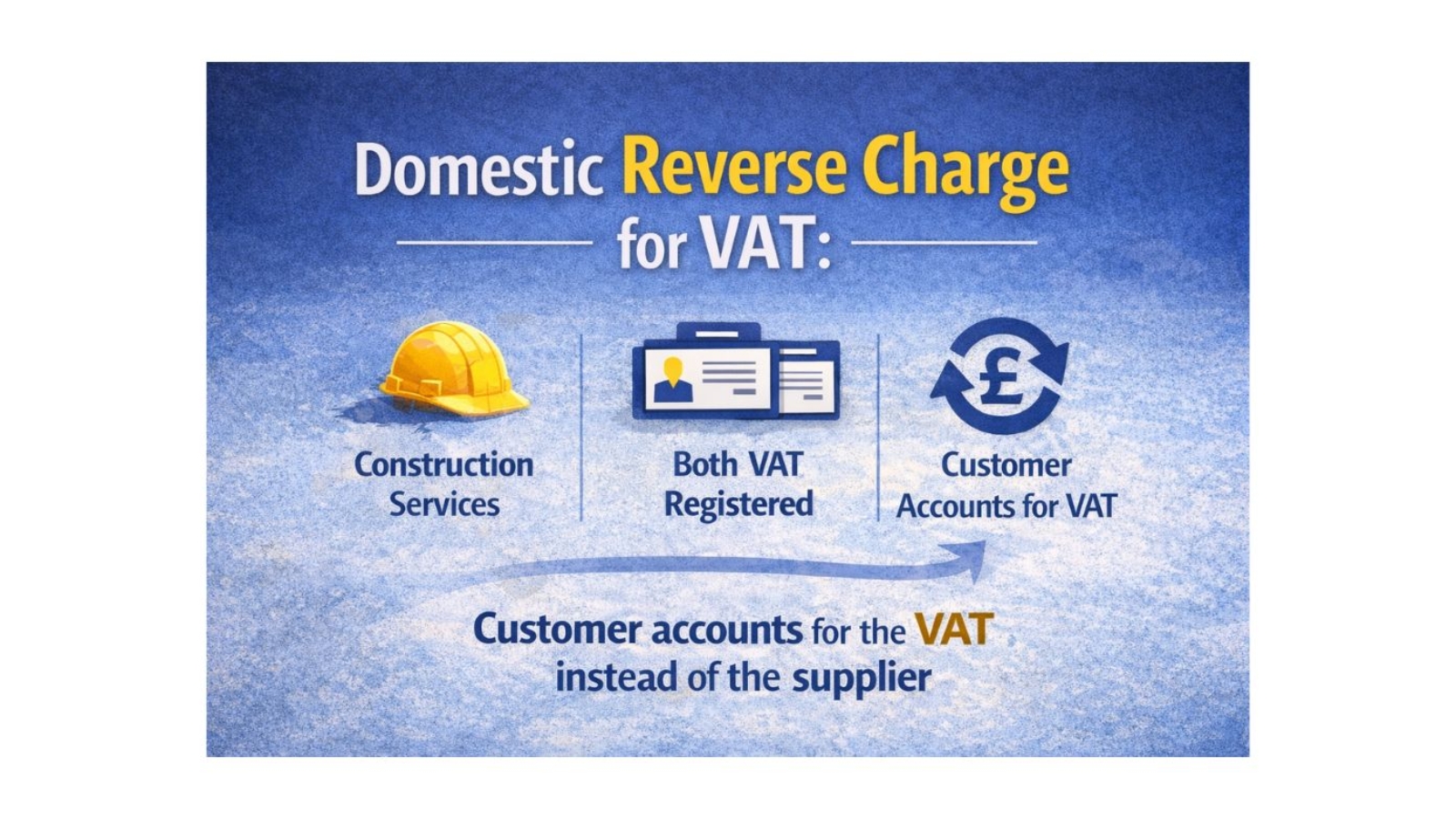
The Domestic Reverse Charge for VAT is a UK VAT rule that changes who is responsible for accounting for VAT on certain business-to-business transactions, mainly within the construction sector. Instead of the supplier charging VAT on an invoice, the customer accounts for the VAT directly on their VAT return.
This rule was introduced by HM Revenue & Customs to reduce VAT fraud and improve transparency within complex supply chains. It applies when both the supplier and customer are VAT registered, the services fall under the Construction Industry Scheme, and the customer is not an end user.
Under the Domestic Reverse Charge, suppliers issue VAT-free invoices that clearly state the reverse charge applies, while customers declare the VAT as output tax and reclaim it as input tax if eligible. Although no VAT is physically exchanged, the transaction remains fully reportable and compliant with HMRC requirements.
For small businesses, particularly subcontractors, the Domestic Reverse Charge can significantly impact cash flow because VAT is no longer received upfront. Accurate bookkeeping, compliant invoicing, and correctly configured accounting software are essential to avoid errors, penalties, and HMRC scrutiny.
Carter Bookkeeping Services Limited helps small businesses understand when the Domestic Reverse Charge applies, ensure VAT compliance, and maintain accurate financial records, allowing business owners to focus on growth with confidence.
Understanding the Domestic Reverse Charge for VAT
The Domestic Reverse Charge for VAT is a mechanism that changes who is responsible for accounting for VAT on certain UK transactions. Instead of the supplier charging VAT on their invoice and later paying that VAT to HMRC, the responsibility shifts to the customer, who must declare the VAT directly on their VAT return.
Under normal VAT rules, a supplier charges VAT to the customer, collects it as part of the payment, and then submits that VAT to HMRC. Under the Domestic Reverse Charge, the supplier issues an invoice without VAT and includes a statement confirming that the reverse charge applies. The customer then records the VAT as output tax and, if eligible, reclaims it as input tax on the same VAT return.
Although no VAT is physically exchanged, the transaction is still fully recorded for VAT purposes. This change is not optional and must be applied correctly where required.
Why the Domestic Reverse Charge Was Introduced
The Domestic Reverse Charge was introduced by HM Revenue & Customs to tackle widespread VAT fraud, particularly within the construction industry. For many years, HMRC identified construction as a high-risk sector due to the complex nature of subcontracting arrangements and long supply chains.
In many fraudulent cases, a supplier would charge VAT to their customer but disappear before paying that VAT to HMRC. This resulted in significant losses to the Treasury. By shifting the responsibility for accounting for VAT to the customer, the Domestic Reverse Charge removes the opportunity for VAT to be collected and misused.
The rule ensures that VAT is declared accurately and transparently while protecting legitimate businesses from being caught up in fraudulent activity elsewhere in the supply chain
Which Businesses Are Affected by the Domestic Reverse Charge
The Domestic Reverse Charge applies primarily to VAT-registered businesses operating within the construction sector where services fall under the Construction Industry Scheme. This includes many small and medium-sized businesses that provide construction-related services to other businesses rather than to private individuals.
If both the supplier and the customer are VAT registered and registered under CIS, the Domestic Reverse Charge will generally apply unless the customer qualifies as an end user. This means that many subcontractors and contractors are affected even if they do not consider themselves large construction firms.
The rule does not apply to businesses that are not VAT registered, nor does it apply to supplies made directly to private individuals or domestic customers. Understanding whether a transaction qualifies is critical, as applying the rule incorrectly can lead to compliance issues.
The Importance of End User Status
The concept of the end user is central to the correct application of the Domestic Reverse Charge. An end user is a customer who receives construction services for their own use and does not make an onward supply of those services. In practical terms, this usually means a business or individual that is not passing the work on to another party as part of a wider construction project.
If the customer is an end user, the Domestic Reverse Charge does not apply, and VAT should be charged in the normal way. However, the end user must confirm their status to the supplier, usually in writing. Without this confirmation, suppliers are expected to apply the Domestic Reverse Charge by default.
This requirement places a responsibility on both parties to communicate clearly, as misunderstandings around end user status are one of the most common causes of VAT errors.
How the Domestic Reverse Charge Works in Real Business Scenarios?
To understand how the Domestic Reverse Charge operates in practice, it is useful to consider a typical construction scenario. A VAT-registered subcontractor provides plastering services to a VAT-registered main contractor on a commercial project. Both businesses are registered under CIS, and the contractor is not an end user.
In this situation, the subcontractor issues an invoice that does not include VAT. The invoice clearly states that the Domestic Reverse Charge applies and shows the VAT rate and amount that would normally have been charged. The contractor then accounts for that VAT on their VAT return by declaring it as output tax and reclaiming it as input tax if they are entitled to do so.
From HMRC’s perspective, the VAT has been properly declared, even though no VAT has changed hands. From the subcontractor’s perspective, their invoicing and cash flow are affected, which is why careful financial planning is essential
Invoicing Correctly Under the Domestic Reverse Charge
Invoices issued under the Domestic Reverse Charge must meet specific requirements to ensure compliance. The invoice must make it clear that the reverse charge applies and must state that the customer is responsible for accounting for VAT to HMRC. It must also show the VAT rate applicable to the supply and the amount of VAT that the customer must account for.
Incorrect invoicing can cause delays in payment, confusion for customers, and errors in VAT returns. Over time, repeated mistakes can attract unwanted attention from HMRC. Ensuring invoices are compliant from the outset is one of the simplest ways to reduce risk.
How the Domestic Reverse Charge Affects VAT Returns?
The Domestic Reverse Charge does not eliminate VAT obligations, but it changes how VAT is reported. Suppliers must still include the net value of the sale on their VAT return, but they do not include any VAT in the output tax section. Customers must include the VAT due under the reverse charge as output tax and reclaim it as input tax if they are entitled to do so.
This dual reporting ensures that VAT is correctly declared without creating a cash flow advantage. However, it also increases the complexity of VAT returns and highlights the importance of accurate bookkeeping records.
Cash Flow Challenges Created by the Domestic Reverse Charge
One of the most significant impacts of the Domestic Reverse Charge for small businesses is its effect on cash flow. Before the introduction of the rule, many subcontractors temporarily held VAT collected from customers before paying it to HMRC. While this was never intended as working capital, it often provided short-term financial flexibility.
Under the Domestic Reverse Charge, that VAT is no longer received. For businesses operating on tight margins, this change can create immediate pressure, particularly if payment terms are long or costs are rising. Many businesses respond by switching to monthly VAT returns, renegotiating payment terms, or adjusting pricing structures to maintain stability.
Professional bookkeeping support can help identify these risks early and implement strategies to protect cash flow.
Accounting Software and the Domestic Reverse Charge
Modern accounting software can handle Domestic Reverse Charge transactions, but only when configured correctly. Incorrect VAT codes, outdated invoice templates, or incomplete setups can result in inaccurate VAT returns and compliance issues.
Small businesses often assume their software is automatically handling everything correctly, but without regular reviews and reconciliations, errors can go unnoticed. Accurate bookkeeping ensures that Domestic Reverse Charge transactions are recorded properly and that VAT returns reflect the true financial position of the business.
Domestic Reverse Charge and the Supply of Materials
The Domestic Reverse Charge applies not only to labour but also to materials supplied as part of a construction service. When materials are supplied alongside labour as part of a single supply, the entire invoice is usually subject to the reverse charge. When materials are supplied on their own without associated construction services, standard VAT rules typically apply.
This distinction is often misunderstood and can lead to incorrect VAT treatment. Clarifying how materials are supplied and invoiced is essential for compliance.
Risks and Consequences of Getting the Domestic Reverse Charge Wrong
Errors relating to the Domestic Reverse Charge can result in penalties, interest charges, and increased scrutiny from HMRC. Even genuine mistakes can trigger compliance checks, which take time and resources away from running the business.
Correcting errors early is always preferable. Regular reviews of invoicing practices, VAT returns, and bookkeeping records can significantly reduce the risk of costly issues.
How Carter Bookkeeping Services Limited Supports Domestic Reverse Charge Compliance?
Carter Bookkeeping Services Limited is your trusted partner in bookkeeping excellence. We provide accurate, reliable, and tailored bookkeeping solutions to help businesses stay financially organised and fully compliant with VAT regulations.
Our team works closely with small businesses to determine whether the Domestic Reverse Charge applies, ensure invoices meet HMRC requirements, configure accounting software correctly, prepare accurate VAT returns, and provide cash flow planning support. Our proactive approach helps businesses remain compliant while gaining clarity and confidence in their financial position.
Frequently Asked Questions About the Domestic Reverse Charge for VAT
What is the Domestic Reverse Charge for VAT in simple terms?
The Domestic Reverse Charge is a VAT rule that shifts the responsibility for declaring VAT from the supplier to the customer on certain UK construction-related transactions.
Who does the Domestic Reverse Charge apply to?
It applies mainly to VAT-registered businesses in the construction sector that are registered under the Construction Industry Scheme and are not end users.
Do both businesses need to be VAT registered?
Yes, both the supplier and the customer must be VAT registered for the Domestic Reverse Charge to apply.
Can VAT be reclaimed under the Domestic Reverse Charge?
If the customer is entitled to reclaim VAT under normal VAT rules, they can usually reclaim the VAT accounted for under the reverse charge on their VAT return.
Does the Domestic Reverse Charge apply to residential customers?
No, it applies only to business-to-business transactions within the UK.
What happens if the Domestic Reverse Charge is applied incorrectly?
Applying the rule incorrectly can lead to VAT errors, penalties, and interest charges. Errors should be corrected as soon as possible, ideally with professional support.
Final Thoughts on the Domestic Reverse Charge for Small Businesses
The Domestic Reverse Charge for VAT is a mandatory rule that affects many UK small businesses, particularly those in the construction sector. While the legislation may appear complex, the underlying principle is straightforward: VAT must be declared correctly, transparently, and without risk of fraud.
With the right bookkeeping support, compliance does not need to be difficult. Carter Bookkeeping Services Limited helps businesses navigate VAT rules with confidence, ensuring accuracy, reliability, and peace of mind.
If you are unsure whether the Domestic Reverse Charge applies to your business or want reassurance that your VAT records are compliant, Carter Bookkeeping Services Limited is here to help.
Stay compliant, protect your cash flow, and focus on growing your business.
Let Carter Bookkeeping Services Limited manage your VAT and bookkeeping with confidence
Add a Comment