Tag: Sole Trader Tax UK

  • What Is the Domestic Reverse Charge for VAT? A Simple Guide for Small Businesses

    What Is the Domestic Reverse Charge for VAT? A Simple Guide for Small Businesses

    VAT compliance is one of the most challenging responsibilities faced by small businesses in the UK. While standard VAT rules already require careful attention, the introduction of the Domestic Reverse Charge has added further complexity, particularly for businesses operating in construction and related trades. Many business owners are unsure whether the rule applies to them, how it affects invoicing, what must be reported to HMRC, and how it impacts cash flow.

    At Carter Bookkeeping Services Limited, we support small businesses with accurate, reliable, and tailored bookkeeping solutions that keep finances organised and compliant. This guide has been written to clearly explain the Domestic Reverse Charge for VAT in a way that is practical, relevant, and easy to understand.

    Domestic Reverse Charge for VAT: quick summary for small businesses

    The Domestic Reverse Charge for VAT is a UK VAT rule that changes who is responsible for accounting for VAT on certain business-to-business transactions, mainly within the construction sector. Instead of the supplier charging VAT on an invoice, the customer accounts for the VAT directly on their VAT return.

    This rule was introduced by HM Revenue & Customs to reduce VAT fraud and improve transparency within complex supply chains. It applies when both the supplier and customer are VAT registered, the services fall under the Construction Industry Scheme, and the customer is not an end user.

    Under the Domestic Reverse Charge, suppliers issue VAT-free invoices that clearly state the reverse charge applies, while customers declare the VAT as output tax and reclaim it as input tax if eligible. Although no VAT is physically exchanged, the transaction remains fully reportable and compliant with HMRC requirements.

    For small businesses, particularly subcontractors, the Domestic Reverse Charge can significantly impact cash flow because VAT is no longer received upfront. Accurate bookkeeping, compliant invoicing, and correctly configured accounting software are essential to avoid errors, penalties, and HMRC scrutiny.

    Carter Bookkeeping Services Limited helps small businesses understand when the Domestic Reverse Charge applies, ensure VAT compliance, and maintain accurate financial records, allowing business owners to focus on growth with confidence.

    Understanding the Domestic Reverse Charge for VAT

    The Domestic Reverse Charge for VAT is a mechanism that changes who is responsible for accounting for VAT on certain UK transactions. Instead of the supplier charging VAT on their invoice and later paying that VAT to HMRC, the responsibility shifts to the customer, who must declare the VAT directly on their VAT return.

    Under normal VAT rules, a supplier charges VAT to the customer, collects it as part of the payment, and then submits that VAT to HMRC. Under the Domestic Reverse Charge, the supplier issues an invoice without VAT and includes a statement confirming that the reverse charge applies. The customer then records the VAT as output tax and, if eligible, reclaims it as input tax on the same VAT return.

    Although no VAT is physically exchanged, the transaction is still fully recorded for VAT purposes. This change is not optional and must be applied correctly where required.

    Why the Domestic Reverse Charge was introduced

    The Domestic Reverse Charge was introduced by HM Revenue & Customs to tackle widespread VAT fraud, particularly within the construction industry. For many years, HMRC identified construction as a high-risk sector due to the complex nature of subcontracting arrangements and long supply chains.

    In many fraudulent cases, a supplier would charge VAT to their customer but disappear before paying that VAT to HMRC. This resulted in significant losses to the Treasury. By shifting the responsibility for accounting for VAT to the customer, the Domestic Reverse Charge removes the opportunity for VAT to be collected and misused.

    The rule ensures that VAT is declared accurately and transparently while protecting legitimate businesses from being caught up in fraudulent activity elsewhere in the supply chain.

    Which businesses are affected by the Domestic Reverse Charge

    The Domestic Reverse Charge applies primarily to VAT-registered businesses operating within the construction sector where services fall under the Construction Industry Scheme. This includes many small and medium-sized businesses that provide construction-related services to other businesses rather than to private individuals.

    If both the supplier and the customer are VAT registered and registered under CIS, the Domestic Reverse Charge will generally apply unless the customer qualifies as an end user. This means that many subcontractors and contractors are affected even if they do not consider themselves large construction firms.

    The rule does not apply to businesses that are not VAT registered, nor does it apply to supplies made directly to private individuals or domestic customers. Understanding whether a transaction qualifies is critical, as applying the rule incorrectly can lead to compliance issues.

    The importance of end user status

    The concept of the end user is central to the correct application of the Domestic Reverse Charge. An end user is a customer who receives construction services for their own use and does not make an onward supply of those services. In practical terms, this usually means a business or individual that is not passing the work on to another party as part of a wider construction project.

    If the customer is an end user, the Domestic Reverse Charge does not apply, and VAT should be charged in the normal way. However, the end user must confirm their status to the supplier, usually in writing. Without this confirmation, suppliers are expected to apply the Domestic Reverse Charge by default.

    This requirement places a responsibility on both parties to communicate clearly, as misunderstandings around end user status are one of the most common causes of VAT errors.

    How the Domestic Reverse Charge works in real business scenarios

    To understand how the Domestic Reverse Charge operates in practice, it is useful to consider a typical construction scenario. A VAT-registered subcontractor provides plastering services to a VAT-registered main contractor on a commercial project. Both businesses are registered under CIS, and the contractor is not an end user.

    In this situation, the subcontractor issues an invoice that does not include VAT. The invoice clearly states that the Domestic Reverse Charge applies and shows the VAT rate and amount that would normally have been charged. The contractor then accounts for that VAT on their VAT return by declaring it as output tax and reclaiming it as input tax if they are entitled to do so.

    From HMRC’s perspective, the VAT has been properly declared, even though no VAT has changed hands. From the subcontractor’s perspective, their invoicing and cash flow are affected, which is why careful financial planning is essential.

    Invoicing correctly under the Domestic Reverse Charge

    Invoices issued under the Domestic Reverse Charge must meet specific requirements to ensure compliance. The invoice must make it clear that the reverse charge applies and must state that the customer is responsible for accounting for VAT to HMRC. It must also show the VAT rate applicable to the supply and the amount of VAT that the customer must account for.

    Incorrect invoicing can cause delays in payment, confusion for customers, and errors in VAT returns. Over time, repeated mistakes can attract unwanted attention from HMRC. Ensuring invoices are compliant from the outset is one of the simplest ways to reduce risk.

    How the Domestic Reverse Charge affects VAT returns

    The Domestic Reverse Charge does not eliminate VAT obligations, but it changes how VAT is reported. Suppliers must still include the net value of the sale on their VAT return, but they do not include any VAT in the output tax section. Customers must include the VAT due under the reverse charge as output tax and reclaim it as input tax if they are entitled to do so.

    This dual reporting ensures that VAT is correctly declared without creating a cash flow advantage. However, it also increases the complexity of VAT returns and highlights the importance of accurate bookkeeping records.

    Cash flow challenges created by the Domestic Reverse Charge

    One of the most significant impacts of the Domestic Reverse Charge for small businesses is its effect on cash flow. Before the introduction of the rule, many subcontractors temporarily held VAT collected from customers before paying it to HMRC. While this was never intended as working capital, it often provided short-term financial flexibility.

    Under the Domestic Reverse Charge, that VAT is no longer received. For businesses operating on tight margins, this change can create immediate pressure, particularly if payment terms are long or costs are rising. Many businesses respond by switching to monthly VAT returns, renegotiating payment terms, or adjusting pricing structures to maintain stability.

    Professional bookkeeping support can help identify these risks early and implement strategies to protect cash flow.

    Accounting software and the Domestic Reverse Charge

    Modern accounting software can handle Domestic Reverse Charge transactions, but only when configured correctly. Incorrect VAT codes, outdated invoice templates, or incomplete setups can result in inaccurate VAT returns and compliance issues.

    Small businesses often assume their software is automatically handling everything correctly, but without regular reviews and reconciliations, errors can go unnoticed. Accurate bookkeeping ensures that Domestic Reverse Charge transactions are recorded properly and that VAT returns reflect the true financial position of the business.

    Domestic Reverse Charge and the supply of materials

    The Domestic Reverse Charge applies not only to labour but also to materials supplied as part of a construction service. When materials are supplied alongside labour as part of a single supply, the entire invoice is usually subject to the reverse charge. When materials are supplied on their own without associated construction services, standard VAT rules typically apply.

    This distinction is often misunderstood and can lead to incorrect VAT treatment. Clarifying how materials are supplied and invoiced is essential for compliance.

    Risks and consequences of getting the Domestic Reverse Charge wrong

    Errors relating to the Domestic Reverse Charge can result in penalties, interest charges, and increased scrutiny from HMRC. Even genuine mistakes can trigger compliance checks, which take time and resources away from running the business.

    Correcting errors early is always preferable. Regular reviews of invoicing practices, VAT returns, and bookkeeping records can significantly reduce the risk of costly issues.

    How Carter Bookkeeping Services Limited supports Domestic Reverse Charge compliance

    Carter Bookkeeping Services Limited is your trusted partner in bookkeeping excellence. We provide accurate, reliable, and tailored bookkeeping solutions to help businesses stay financially organised and fully compliant with VAT regulations.

    Our team works closely with small businesses to determine whether the Domestic Reverse Charge applies, ensure invoices meet HMRC requirements, configure accounting software correctly, prepare accurate VAT returns, and provide cash flow planning support. Our proactive approach helps businesses remain compliant while gaining clarity and confidence in their financial position.

    Frequently asked questions about the Domestic Reverse Charge for VAT

    What is the Domestic Reverse Charge for VAT in simple terms?

    The Domestic Reverse Charge is a VAT rule that shifts the responsibility for declaring VAT from the supplier to the customer on certain UK construction-related transactions.

    Who does the Domestic Reverse Charge apply to?

    It applies mainly to VAT-registered businesses in the construction sector that are registered under the Construction Industry Scheme and are not end users.

    Do both businesses need to be VAT registered?

    Yes, both the supplier and the customer must be VAT registered for the Domestic Reverse Charge to apply.

    Can VAT be reclaimed under the Domestic Reverse Charge?

    If the customer is entitled to reclaim VAT under normal VAT rules, they can usually reclaim the VAT accounted for under the reverse charge on their VAT return.

    Does the Domestic Reverse Charge apply to residential customers?

    No, it applies only to business-to-business transactions within the UK.

    What happens if the Domestic Reverse Charge is applied incorrectly?

    Applying the rule incorrectly can lead to VAT errors, penalties, and interest charges. Errors should be corrected as soon as possible, ideally with professional support.

    Final thoughts on the Domestic Reverse Charge for small businesses

    The Domestic Reverse Charge for VAT is a mandatory rule that affects many UK small businesses, particularly those in the construction sector. While the legislation may appear complex, the underlying principle is straightforward: VAT must be declared correctly, transparently, and without risk of fraud.

    With the right bookkeeping support, compliance does not need to be difficult. Carter Bookkeeping Services Limited helps businesses navigate VAT rules with confidence, ensuring accuracy, reliability, and peace of mind.

    If you are unsure whether the Domestic Reverse Charge applies to your business or want reassurance that your VAT records are compliant, Carter Bookkeeping Services Limited is here to help.

    Stay compliant, protect your cash flow, and focus on growing your business. Let Carter Bookkeeping Services Limited manage your VAT and bookkeeping with confidence.
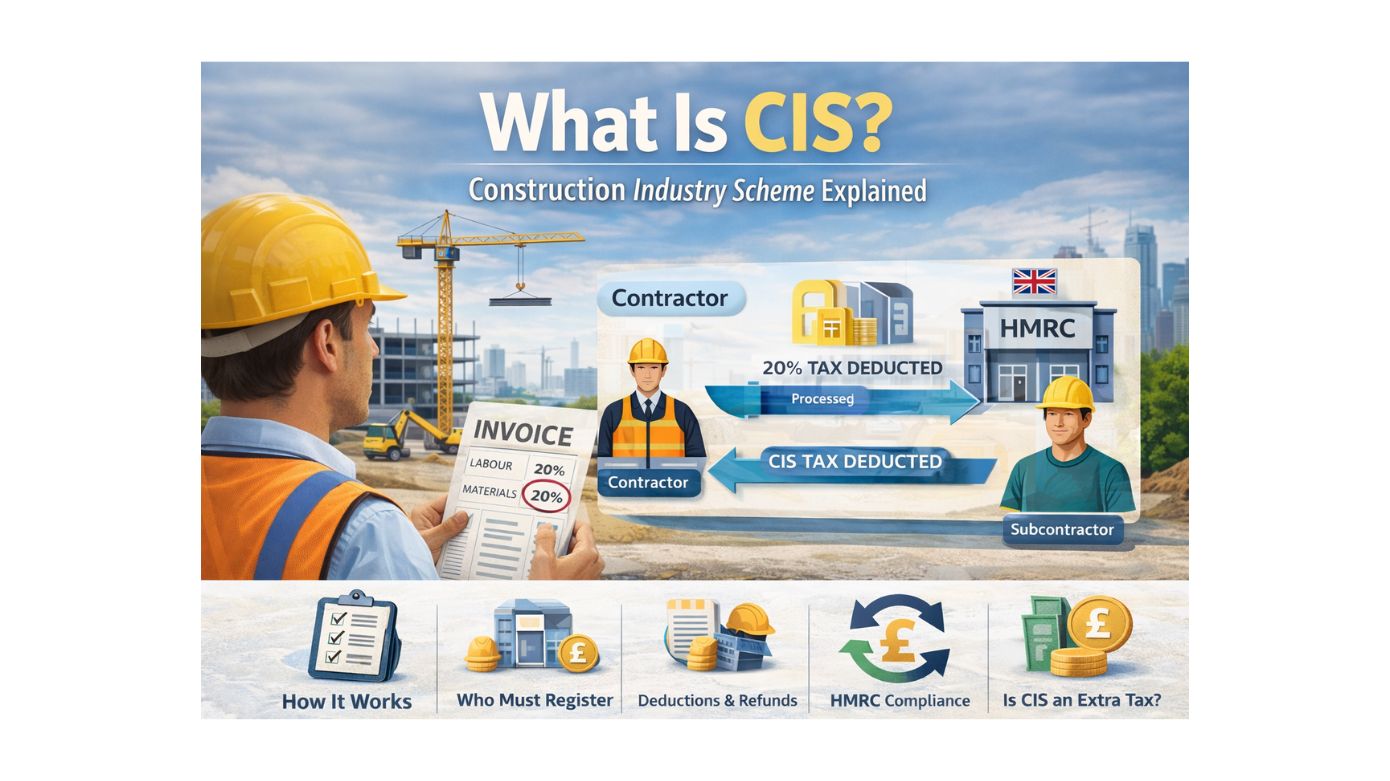
  • What Is CIS (Construction Industry Scheme)? A Simple Guide for UK Contractors

    What Is CIS (Construction Industry Scheme)? A Simple Guide for UK Contractors

    The UK construction industry operates differently from many other sectors when it comes to tax. It relies heavily on self-employed workers, subcontractors and businesses working across multiple short-term projects, which can make tax reporting more complicated.

    The Construction Industry Scheme, commonly known as CIS, was introduced to manage how tax is deducted from payments made for construction work.

    If you are a contractor, subcontractor, sole trader or limited company working within construction, understanding CIS is essential. It affects how subcontractors are verified, how payments are calculated, how much money is deducted and how those deductions are reported to HMRC.

    This guide explains what CIS is, who must register, which work is covered and how contractors and subcontractors should manage their responsibilities.

    What Is the Construction Industry Scheme?

    The Construction Industry Scheme is a tax deduction system for payments made within the UK construction industry.

    Under CIS, contractors may need to deduct money from payments made to subcontractors and pass those deductions to HMRC. The subcontractor receives the remaining net payment.

    The amount deducted is treated as an advance payment towards the subcontractor’s tax liabilities. It is not an additional tax charged on top of the tax the subcontractor already owes.

    At the end of the relevant accounting period:

    • Sole traders and partners report their full income and CIS deductions through Self Assessment.
    • Limited companies normally offset CIS deductions suffered through their payroll reporting.
    • Any remaining tax liability must still be paid.
    • A repayment may be due where deductions exceed the final liability.

    Why Does CIS Exist?

    The construction industry regularly uses subcontracted labour, temporary engagements and project-based working arrangements. This flexibility is commercially useful, but it can make tax collection and reporting harder to monitor.

    CIS creates a structured process under which contractors:

    • Check the tax status of subcontractors.
    • Apply the deduction rate given by HMRC.
    • Report subcontractor payments every month.
    • Pay deductions to HMRC.
    • Give subcontractors evidence of the deductions made.

    For subcontractors, CIS spreads tax deductions across the year rather than leaving the entire liability to be settled after the tax year ends.

    However, CIS does not guarantee that the correct final amount of tax has been paid. Subcontractors must still complete the appropriate tax reporting and settle any remaining balance.

    Who Does CIS Apply To?

    CIS affects contractors who pay for construction work and subcontractors who are paid to carry it out.

    Contractors

    You normally count as a CIS contractor if you pay subcontractors to carry out construction work.

    This includes traditional construction businesses such as builders, property developers and civil engineering companies.

    A business whose main activity is not construction can also become a deemed contractor if it spends more than £3 million on construction work during the 12 months following its first relevant payment.

    Contractors must register for CIS before operating the scheme.

    Subcontractors

    A subcontractor is an individual or business that carries out construction work for a contractor.

    A subcontractor can operate as:

    • A sole trader.
    • A partnership.
    • A limited company.
    • A trust or another qualifying business structure.

    Subcontractors are not legally required to register for CIS, but an unregistered or unverifiable subcontractor will normally have deductions made at the higher rate of 30%.

    A business can be both a contractor and a subcontractor. For example, a building company may be paid as a subcontractor on one development while employing its own subcontractors on another project.

    CIS Does Not Apply to Employees

    CIS applies to self-employed subcontractors, not employees who should be paid through PAYE.

    Registering a worker under CIS does not automatically make that person self-employed. The contractor must consider the reality of the engagement, including how the work is controlled, whether substitution is allowed, who carries financial risk and how the working relationship operates.

    When submitting a monthly CIS return, the contractor must declare that the employment status of the subcontractors has been considered.

    Incorrectly treating an employee as a subcontractor can lead to unpaid PAYE, National Insurance contributions, interest and penalties.

    What Construction Work Is Covered by CIS?

    CIS covers most construction work carried out on permanent or temporary buildings, structures and civil engineering projects in the UK.

    Work commonly covered by CIS includes:

    • Site preparation and groundworks.
    • Building and structural work.
    • Alterations and extensions.
    • Repairs and renovations.
    • Demolition and dismantling.
    • Bricklaying and plastering.
    • Carpentry and joinery.
    • Roofing.
    • Painting and decorating.
    • Installing heating, lighting, power, water and ventilation systems.
    • Internal cleaning carried out as part of an ongoing construction project.
    • Scaffolding and other work integral to the construction operation.

    Work That May Be Excluded

    Some activities connected with the construction industry are excluded when supplied independently. These can include:

    • Architectural and surveying services carried out in a normal professional capacity.
    • Consultancy work involving designs, plans or technical reports without responsibility for supervising construction labour.
    • The manufacture and delivery of construction materials where no installation or construction work is included.
    • The delivery of materials without labour.
    • Carpet fitting supplied as a standalone service.
    • Site services such as catering, medical services or security where they do not form part of construction operations.

    Mixed contracts need particular care. If a contract includes both construction and non-construction work, the entire payment may fall within CIS.

    What Must a CIS Contractor Do?

    Operating CIS involves more than simply deducting 20% from an invoice. Contractors must follow a sequence of checks, calculations and reporting obligations.

    1. Register as a contractor. The business must register with HMRC before it begins operating CIS.
    2. Check employment status. The contractor must establish that the worker is genuinely self-employed for the engagement.
    3. Verify the subcontractor. HMRC will confirm whether deductions should be made at 20%, 30% or 0%.
    4. Calculate the deduction correctly. VAT and qualifying material costs must be excluded before the deduction percentage is applied.
    5. Pay the subcontractor. The contractor pays the net amount after any required deduction.
    6. Provide a payment and deduction statement. Where a deduction is made, the statement must normally be provided within 14 days after the end of the relevant tax month.
    7. Submit a monthly CIS return. The return reports payments and deductions for the relevant tax month.
    8. Pay deductions to HMRC. The deductions are paid alongside PAYE and National Insurance liabilities.
    9. Maintain complete records. Invoices, calculations, statements and verification details must be retained.

    How to Verify a Subcontractor

    Before making the first payment to a subcontractor, a contractor may need to verify them through HMRC’s CIS service or recognised commercial software.

    The contractor will usually need details such as the subcontractor’s:

    • Legal or trading name.
    • Unique Taxpayer Reference.
    • National Insurance number for a sole trader.
    • Company registration number for a limited company.
    • Partnership details where applicable.

    HMRC will provide the deduction status and, where appropriate, a verification reference number.

    A subcontractor used previously may need to be verified again if they have not appeared on a CIS return during the current or previous two tax years.

    CIS Deduction Rates

    Subcontractor Status Deduction Rate What It Means
    Registered subcontractor 20% The standard rate is deducted from the qualifying part of the payment.
    Unregistered or unverifiable subcontractor 30% The higher rate applies where HMRC cannot confirm standard or gross payment status.
    Gross payment status 0% The subcontractor is paid without CIS deductions and remains responsible for paying its tax liabilities.

    The contractor should always use the rate provided by HMRC during verification rather than assuming which rate applies.

    How Are CIS Deductions Calculated?

    CIS deductions are not necessarily applied to the full value of the subcontractor’s invoice.

    The contractor begins with the gross invoice amount and removes amounts relating to:

    • VAT.
    • Materials purchased directly by the subcontractor.
    • Consumable stores that become unusable through the work.
    • Fuel used for the work, excluding ordinary travelling costs.
    • Plant hire for the job.
    • The cost of manufacturing or prefabricating materials.

    The relevant CIS percentage is then applied to the amount remaining.

    Example of a CIS Deduction

    A registered subcontractor submits the following invoice:

    • Labour: £4,000
    • Qualifying materials purchased by the subcontractor: £1,000
    • Subtotal before VAT: £5,000
    • VAT: £1,000
    • Total invoice: £6,000

    The deduction is calculated on the £4,000 labour element:

    £4,000 × 20% = £800 CIS deduction.

    The subcontractor would receive £5,200, consisting of the £4,000 labour charge, £1,000 materials and £1,000 VAT, less the £800 deduction.

    The contractor should retain evidence supporting the material costs. Estimating or excluding unsupported material amounts can lead to an incorrect deduction.

    Gross Payment Status

    Gross payment status allows an eligible subcontractor to receive payments without CIS deductions.

    This can improve cash flow, but it does not remove the subcontractor’s tax obligations. The business must still report its income and pay Income Tax, National Insurance or Corporation Tax as applicable.

    To qualify, the business must satisfy HMRC that:

    • It carries out construction work or provides labour for construction work in the UK.
    • It operates through a bank account.
    • It has maintained an acceptable record of tax compliance.
    • It meets the applicable turnover test.

    The minimum qualifying turnover, excluding VAT and materials, is generally:

    • £30,000 for a sole trader.
    • £30,000 for each partner or at least £100,000 for the partnership.
    • £30,000 for each director or at least £100,000 for the company.

    HMRC reviews gross payment status regularly. Late returns, unpaid tax or other compliance failures can place the status at risk.

    Monthly CIS Returns and Deadlines

    The CIS tax month runs from the sixth day of one month to the fifth day of the following month.

    Contractors must submit their monthly return by the 19th following the end of the tax month.

    For example, a return covering payments made between 6 May and 5 June must reach HMRC by 19 June.

    The return must include:

    • The subcontractors paid during the period.
    • The gross amounts paid before VAT.
    • Relevant material costs.
    • The deductions made.
    • Confirmation that employment status was considered.
    • Confirmation that subcontractors requiring verification were verified.

    CIS deductions must normally be paid to HMRC by the 22nd of the month where payment is made electronically, or by the 19th where payment is sent by post.

    Nil Returns From April 2026

    From 6 April 2026, a mainstream contractor that has not paid any subcontractors during a CIS tax month must either:

    • Submit a nil return by the 19th; or
    • Tell HMRC in advance that the scheme will be inactive.

    A contractor expecting to make no subcontractor payments for several months can request that the scheme be made inactive for up to six months.

    Payment and Deduction Statements

    Where a CIS deduction is made, the contractor must provide the subcontractor with a payment and deduction statement.

    The statement should show:

    • The contractor’s details.
    • The subcontractor’s details.
    • The gross payment.
    • The cost of materials.
    • The CIS deduction.
    • The relevant tax month.

    The statement must normally be provided within 14 days after the end of the tax month. For example, a statement covering 6 May to 5 June should be supplied by 19 June.

    Subcontractors should retain every statement because it provides evidence of the tax deducted from their income.

    CIS and VAT

    CIS and VAT are separate systems, but both can apply to the same construction transaction.

    VAT is excluded before the CIS deduction is calculated. The subcontractor’s gross payment reported on the CIS return is also recorded before VAT.

    Some construction transactions are additionally affected by the VAT domestic reverse charge. Where the reverse charge applies, the customer accounts for the VAT rather than paying it to the supplier.

    The VAT reverse charge has separate conditions and should not be assumed to apply merely because a transaction falls within CIS.

    Accurate VAT records and returns are particularly important where a business operates both CIS and the domestic reverse charge.

    CIS for Sole Traders and Partnerships

    A sole trader or partner who has CIS deductions taken must still report the full value of their income through Self Assessment.

    The tax return should include:

    • The full gross income shown on invoices.
    • Allowable business expenses.
    • The CIS deductions shown on payment and deduction statements.

    HMRC calculates the final Income Tax and National Insurance liability and deducts the CIS tax already withheld.

    If the CIS deductions exceed the amount owed, a repayment may be due. If the deductions are insufficient, the remaining balance must be paid.

    CIS deductions do not remove the obligation to submit a tax return.

    CIS for Limited Companies

    Limited companies must handle deductions suffered differently from sole traders.

    A company paid under deduction should not normally claim the deductions directly through its Corporation Tax return.

    Instead, the company reports the year-to-date CIS deductions through an Employer Payment Summary as part of its payroll reporting.

    HMRC offsets the CIS deductions against amounts the company owes for:

    • PAYE Income Tax.
    • Employer and employee National Insurance contributions.
    • Student Loan deductions.
    • CIS deductions the company has made from its own subcontractors.

    Where the amount suffered exceeds the company’s liabilities for a month or quarter, the balance is carried forward within the same tax year.

    After the end of the tax year, any excess that cannot be offset may be refunded or applied against Corporation Tax once the final payroll submissions have been received.

    Accurate payroll and CIS records are essential because HMRC may request evidence supporting the amount claimed.

    How Long Must CIS Records Be Kept?

    Contractors must keep their CIS records for at least three years after the end of the tax year to which they relate.

    Records should include:

    • Subcontractor invoices.
    • Verification details and reference numbers.
    • Evidence of material costs.
    • Payment records.
    • CIS deduction calculations.
    • Monthly return information.
    • Payment and deduction statements.
    • Records of deductions offset through payroll.

    Records must be made available if requested by HMRC. Missing records can lead to penalties and make it difficult for subcontractors to prove deductions or claim repayments.

    CIS Penalties for Late Returns

    Monthly CIS returns must be filed by the 19th. Automatic penalties can apply even where the return is nil or no deduction is payable.

    How Late the Return Is Potential Penalty
    One day late £100
    Two months late An additional £200
    Six months late £300 or 5% of the deductions due, whichever is higher
    Twelve months late A further penalty of at least £300 or 5% of the deductions due, with higher penalties possible where information was deliberately withheld

    HMRC can also impose penalties for inaccurate returns, incorrect employment-status declarations, missing deduction statements and failure to produce records.

    Common CIS Mistakes

    CIS errors often result from treating the scheme as a simple deduction rather than a complete reporting process.

    • Failing to register as a contractor: Businesses may begin paying subcontractors without setting up the required CIS and PAYE processes.
    • Not checking employment status: A worker may be treated as self-employed even though the engagement should fall under PAYE.
    • Failing to verify subcontractors: This can lead to the wrong deduction rate being used.
    • Deducting CIS from VAT: VAT must be removed before the deduction is calculated.
    • Deducting CIS from legitimate material costs: This can reduce the subcontractor’s payment incorrectly.
    • Accepting unsupported material figures: Contractors should obtain appropriate evidence or make a reasonable assessment.
    • Missing monthly returns: Late returns can trigger automatic penalties.
    • Failing to submit nil returns: Mainstream contractors must file a nil return or notify HMRC of inactivity from April 2026.
    • Not issuing deduction statements: Subcontractors need these statements to support their tax claims.
    • Limited companies claiming deductions incorrectly: Deductions suffered should normally be reported through payroll rather than claimed directly on the Corporation Tax return.

    How CIS Affects Cash Flow

    CIS can have a significant effect on the cash available to subcontractors.

    A subcontractor paid under deduction receives less money than the gross value of the work completed. Materials, fuel, insurance, wages and other operating costs may still need to be paid in full.

    Good CIS bookkeeping helps a subcontractor understand:

    • Total gross income earned.
    • Total deductions suffered.
    • Net cash received.
    • Outstanding customer payments.
    • Expected VAT, payroll and tax liabilities.
    • Whether a repayment may be due.

    Subcontractors should not treat a potential CIS repayment as guaranteed working capital. The final position depends on taxable profit, other liabilities and the accuracy of the records submitted.

    Why Professional CIS Bookkeeping Matters

    CIS combines subcontractor verification, payment calculations, monthly reporting, payroll, VAT and tax records. A mistake in one part of the process can affect several other filings.

    Professional bookkeeping support can help contractors and subcontractors:

    • Register for CIS correctly.
    • Verify subcontractors before payment.
    • Separate labour, materials and VAT accurately.
    • Calculate deductions using the correct rate.
    • Prepare and submit monthly returns.
    • Maintain deduction statements and supporting records.
    • Reconcile deductions suffered by subcontractors.
    • Coordinate CIS with VAT and payroll reporting.
    • Prepare accurate year-end information.

    This reduces administrative pressure and gives the business a clearer view of its cash flow and tax position.

    Frequently Asked Questions About CIS

    What Does CIS Stand For?

    CIS stands for the Construction Industry Scheme. It governs how contractors report payments to subcontractors and deduct advance tax from qualifying construction payments.

    Who Must Register for CIS?

    A business that pays subcontractors for construction work must normally register as a contractor. A non-construction business may also need to register if it meets the £3 million construction expenditure test.

    Subcontractors should register if they want to avoid the 30% higher deduction rate.

    Is CIS an Additional Tax?

    No. CIS deductions are advance payments towards the subcontractor’s eventual tax liabilities. The final position is calculated through Self Assessment or the relevant company reporting process.

    How Much Is Deducted Under CIS?

    The standard rate is 20% for a registered subcontractor. The higher rate is 30% where the subcontractor is not registered or cannot be verified. No deduction is made where HMRC confirms gross payment status.

    Does CIS Apply to Materials?

    CIS deductions are not normally applied to qualifying materials purchased directly by the subcontractor. The contractor should obtain evidence or make a reasonable assessment of those costs before calculating the deduction.

    Is VAT Included in the CIS Deduction?

    No. VAT is excluded before the CIS deduction percentage is applied.

    Do I Still Need to File a Tax Return?

    Yes. CIS deductions do not replace Self Assessment, Corporation Tax or payroll reporting. The deductions must be recorded through the correct process so they can be offset against the final liability.

    Can I Claim a CIS Tax Refund?

    A repayment may be due where the deductions suffered exceed the final liabilities. Sole traders normally establish this through Self Assessment. Limited companies claim deductions through payroll and may request repayment of any remaining balance after the tax year.

    Can a Business Be Both a Contractor and a Subcontractor?

    Yes. A business may receive payments under CIS while also making payments to its own subcontractors. It must maintain records for both sides of the scheme.

    Do I Need to File a Nil CIS Return?

    From 6 April 2026, mainstream contractors that make no subcontractor payments during a tax month must file a nil return or notify HMRC of a period of inactivity.

    How Long Must CIS Records Be Retained?

    Contractors must retain CIS records for at least three years after the end of the tax year to which they relate.

    Get Help With CIS Bookkeeping

    The Construction Industry Scheme is manageable when registrations, verifications, deductions and monthly returns are handled consistently. Problems arise when records are incomplete, deduction calculations are incorrect or reporting is left until the deadline.

    Carter Bookkeeping Services Limited supports contractors and subcontractors across the UK with accurate CIS bookkeeping. We can assist with registrations, subcontractor verifications, deduction records, monthly returns, payroll reporting, VAT and year-end reconciliation.

    Contact Carter Bookkeeping Services Limited to discuss your current CIS process and the support your construction business requires.

  • Are Sole Traders & Landlords Ready for Making Tax Digital for Income Tax?

    Are Sole Traders & Landlords Ready for Making Tax Digital for Income Tax?

    Making Tax Digital for Income Tax is no longer a future consideration for sole traders and landlords in the UK. It is a confirmed and steadily approaching change that will fundamentally reshape how income tax is reported, how records are kept, and how often HMRC expects updates.

    From April 2026, many individuals who currently submit a single Self-Assessment tax return each year will move onto a system of digital record keeping and quarterly reporting under Making Tax Digital for Income Tax Self-Assessment (MTD ITSA). For others, the change will follow in 2027 and beyond.

    While the concept of MTD has been discussed for years, its practical impact is only now becoming clear. For sole traders and landlords, this is not just a technical update, it is a shift in mindset, habits, and financial management.

    So, the question is an important one: are sole traders and landlords ready for Making Tax Digital for Income Tax?

    This guide explains what MTD ITSA means in practical terms, who must comply, how it affects day-to-day working, and what you can do now to prepare confidently.

    What is Making Tax Digital for Income Tax?

    Understanding ITSA and MTD ITSA

    Income Tax Self-Assessment (ITSA) is the system used by HMRC to collect tax from people whose income is not fully taxed at source. This includes self-employed individuals and landlords, who currently report income and expenses once a year via a Self-Assessment tax return.

    Making Tax Digital for Income Tax, commonly referred to as MTD ITSA, replaces this annual reporting process with a digital and ongoing system. Rather than preparing everything at the end of the tax year, taxpayers must keep digital records and submit quarterly updates to HMRC using compatible software.

    The intention behind MTD ITSA is to reduce errors, improve accuracy, and give taxpayers better visibility of their tax position throughout the year.

    When does MTD for Income Tax start?

    MTD ITSA is being introduced gradually based on income thresholds.

    From 6 April 2026, MTD ITSA becomes mandatory for sole traders and landlords whose combined gross income from self-employment and/or rental income exceeds £50,000.

    From 6 April 2027, the threshold reduces to £30,000, bringing a much wider group into scope.

    The government has also confirmed plans to extend MTD further in future, meaning smaller businesses and landlords should not assume they will remain outside the system indefinitely.

    A key point often misunderstood is that HMRC considers gross income, not profit, and income from multiple sources is added together. For example, modest self-employment income combined with rental income could easily push someone over the threshold.

    Who does MTD ITSA apply to?

    MTD ITSA applies to individuals, not companies. It is specifically aimed at:

    • Sole traders
    • Individual landlords
    • Individuals with both self-employment and rental income

    Some people may be exempt due to age, disability, or lack of digital access, but exemptions are not automatic and must be formally agreed with HMRC.

    For most sole traders and landlords who earn above the thresholds, MTD ITSA will be unavoidable.

    What will change under MTD for Income Tax?

    Although tax rules themselves largely remain the same, how and when information is reported changes significantly.

    Digital record keeping becomes essential

    MTD ITSA requires records to be kept digitally. This means moving away from paper files, manual summaries, and informal spreadsheets that are not digitally linked to HMRC.

    Income and expenses must be recorded in a structured digital format that software can summarise and submit without manual re-entry. For many, this will mean adopting cloud accounting software or upgrading existing systems.

    Quarterly updates replace annual catch-ups

    Instead of reporting everything once a year, MTD ITSA introduces quarterly updates for each source of income.

    These updates provide HMRC with a snapshot of income and expenses for that quarter. They are not final tax calculations, but they form part of the overall reporting process.

    At the end of the tax year, figures are adjusted and confirmed through year-end submissions.

    End of Period Statement and Final Declaration

    Under MTD ITSA, the traditional Self-Assessment tax return is replaced by an End of Period Statement, which finalises income and expenses for each business or property source, and a Final Declaration, which brings together all taxable income and confirms the final tax liability.

    The final declaration deadline remains similar to the current system, but the work leading up to it is spread across the year.

    Penalties and why preparation matters

    HMRC is introducing a points-based penalty system alongside MTD ITSA. Each missed submission earns a penalty point, and once a threshold is reached, financial penalties apply.

    Although HMRC has announced a more flexible approach during the initial transition, this should not be mistaken for long-term leniency. Over time, consistent late submissions or poor record keeping will lead to penalties and increased scrutiny.

    This makes preparation critical. Being partially ready or intending to “catch up later” is a risky strategy under MTD.

    Are sole traders ready for MTD ITSA?

    Many sole traders still prepare their accounts retrospectively, often months after the tax year ends. While this has worked under the traditional Self-Assessment system, it is poorly suited to MTD ITSA.

    MTD requires more frequent engagement with finances, regular record keeping, and a clearer separation between business and personal transactions.

    Sole traders with fluctuating income or multiple revenue streams may benefit from this increased visibility, but only if systems are set up correctly and used consistently.

    Are landlords ready for MTD ITSA?

    Landlords face their own challenges with MTD ITSA, especially those with multiple properties or joint ownership arrangements.

    Rental income and expenses must be recorded accurately and consistently throughout the year. While HMRC does not require submissions per property, good digital records are essential for compliance, planning, and portfolio performance.

    For many landlords, MTD ITSA highlights weaknesses in existing record-keeping practices that need addressing well before mandatory start dates.

    How MTD ITSA changes cash flow awareness

    Although MTD ITSA does not change when tax is ultimately payable, it significantly improves visibility.

    Instead of discovering liabilities at year end, taxpayers receive ongoing estimates based on submitted data. This encourages better budgeting, fewer payment surprises, and improved cash flow planning.

    Over time, this shift can reduce reliance on time-to-pay arrangements and late payments.

    Choosing the right software

    MTD ITSA requires compatible software, but the best solution varies from person to person.

    Some sole traders and landlords prefer intuitive cloud-based platforms with bank feeds and automation. Others may use enhanced spreadsheets connected to HMRC through bridging software.

    The most important factor is that the system is compliant, reliable, and something you can realistically maintain.

    Choosing unsuitable software often leads to frustration, errors, and revert-to-old-habits behaviour that causes compliance problems later.

    The growing role of professional support

    As tax becomes more digital, the role of accountants and bookkeepers becomes more proactive. Rather than stepping in once a year, professionals now support clients throughout the year.

    For many sole traders and landlords, this ongoing support is not just convenient but essential, particularly as reporting frequency increases and penalties become stricter.

    How Carter Bookkeeping Services can help sole traders and landlords

    Making Tax Digital for Income Tax is not just a compliance exercise. It requires the right systems, consistent processes, and ongoing confidence that everything is being done correctly.

    Carter Bookkeeping Services Limited specialises in supporting sole traders and landlords through the transition to MTD ITSA and beyond.

    Understanding when MTD applies to you

    Every client starts in a different position. Carter Bookkeeping Services Limited reviews your income sources and levels to confirm exactly when MTD ITSA applies, whether that is April 2026, April 2027, or later. This clarity allows you to plan properly rather than reacting at the last minute.

    Setting up MTD-compliant systems

    Moving to digital records can feel overwhelming, especially if you’re used to traditional methods. Carter Bookkeeping Services Limited helps you select and implement MTD-compatible software that suits your business or property income, ensuring it is set up correctly from day one. The focus is on systems that are practical, compliant, and sustainable.

    Ongoing bookkeeping and quarterly submissions

    MTD ITSA is about consistency. Carter Bookkeeping Services Limited provides ongoing bookkeeping support to ensure records are maintained accurately throughout the year and quarterly updates are submitted on time. This removes the pressure of deadlines and reduces the risk of penalties.

    Specialist support for landlords and sole traders

    Sole traders benefit from streamlined systems that separate business and personal finances, while landlords receive support tailored to rental income, allowable expenses, and portfolio management. In both cases, the aim is accuracy, clarity, and peace of mind.

    Year-end compliance and final declarations

    Carter Bookkeeping Services Limited also manages End of Period Statements and Final Declarations, ensuring that year-end submissions remain correct, complete, and compliant with HMRC requirements. Clients benefit from continuity, with the same professionals overseeing records throughout the year.

    Peace of mind as rules continue to change

    MTD ITSA is not static. Guidance evolves, thresholds may change, and compliance expectations increase over time. Carter Bookkeeping Services Limited stays on top of these developments so clients do not have to. This proactive support allows you to focus on running your business or managing your properties with confidence.

    Frequently asked questions about MTD ITSA

    What is Making Tax Digital for Income Tax (MTD ITSA)?

    Making Tax Digital for Income Tax Self-Assessment (MTD ITSA) is an HMRC system that requires sole traders and landlords to keep digital records and submit quarterly summaries of income and expenses using approved software, replacing the traditional annual Self-Assessment tax return.

    Who needs to comply with MTD ITSA?

    MTD ITSA applies to UK sole traders and individual landlords with combined gross income from self-employment and/or rental property over £50,000 from April 2026, and over £30,000 from April 2027. Income from all qualifying sources is added together.

    When does MTD for Income Tax become mandatory?

    MTD for Income Tax becomes mandatory from 6 April 2026 for individuals earning over £50,000, and from 6 April 2027 for those earning over £30,000. The income thresholds are based on your previous tax return.

    Does MTD ITSA apply to landlords?

    Yes. MTD ITSA applies to individual landlords with qualifying rental income above the threshold, regardless of whether they are also self-employed. Rental income and sole trader income are combined when assessing whether MTD applies.

    What counts as qualifying income for MTD ITSA?

    Qualifying income includes gross income from self-employment and UK property rental income before expenses are deducted. It does not include employment income taxed through PAYE or income from limited companies.

    Will I need to pay income tax quarterly under MTD?

    No. MTD ITSA requires quarterly reporting of income and expenses, not quarterly tax payments. Final income tax payments are still due after the end of the tax year, based on HMRC deadlines.

    What are quarterly updates under MTD ITSA?

    Quarterly updates are digital summaries of income and expenses sent to HMRC every three months using compatible software. These updates show estimated figures and do not finalise your tax liability.

    What is an End of Period Statement (EOPS)?

    An End of Period Statement is a year-end submission that finalises income and expenses for each business or property source under MTD ITSA. It replaces parts of the traditional Self-Assessment process.

    What is the Final Declaration under MTD ITSA?

    The Final Declaration replaces the annual Self-Assessment tax return. It confirms all income sources, reliefs, and allowances and finalises the total income tax owed for the year.

    What software is required for MTD ITSA?

    You must use HMRC-approved MTD-compatible software or spreadsheets connected via bridging software. The software must be able to create and submit digital records and quarterly updates.

    What penalties apply if I miss MTD deadlines?

    HMRC operates a points-based penalty system for late MTD submissions. Missing quarterly updates or year-end submissions earns penalty points, which lead to financial penalties once a threshold is reached.

    Can my bookkeeper or accountant submit MTD updates for me?

    Yes. Sole traders and landlords can authorise a bookkeeper or accountant to manage digital records and submit quarterly updates and annual declarations on their behalf.

    Is it worth preparing for MTD ITSA early?

    Yes. Preparing early allows you to choose suitable software, improve record-keeping habits, avoid rushed compliance, and reduce the risk of errors and penalties when MTD becomes mandatory.

    How can Carter Bookkeeping Services help with MTD ITSA?

    Carter Bookkeeping Services supports sole traders and landlords by assessing MTD readiness, setting up compliant digital systems, managing ongoing bookkeeping, submitting quarterly updates, and handling year-end declarations to ensure full HMRC compliance.

    Final thoughts

    Making Tax Digital for Income Tax represents one of the biggest changes UK sole traders and landlords have faced in years. While it introduces new obligations, it also creates opportunities for better financial control and planning.

    Those who prepare early, adopt suitable systems, and seek the right support will find the transition manageable and, in many cases, beneficial.

    If you are a sole trader or landlord approaching the income thresholds, now is the time to act. With the right guidance, MTD ITSA does not have to be overwhelming.

    For tailored advice and ongoing support, Carter Bookkeeping Services Limited is well placed to help you navigate the digital future of tax with confidence. Contact us today to discuss your situation and start preparing for MTD ITSA confidently and compliantly.